
Most founders don’t lose investors on the vision slide. They lose them on the numbers, usually because the financial model behind the pitch can’t answer the second question. “Why does revenue triple in Year 2?” “When do you run out of cash?” “What happens if sales take twice as long?”
A good financial model for investor pitch decks answers those questions before they’re asked. You don’t need spreadsheet skills to build one. You need the right structure, a handful of honest assumptions, and a clear link between the money you’re raising and what it buys.
Key takeaways
- Use a 3-year model at pre-seed and seed. Move to 5 years at Series A or if your business takes longer to mature.
- Build revenue bottom-up from drivers (customers, price, conversion), not top-down from market size.
- Your model needs three connected statements: P&L, balance sheet and cash flow.
- The round size should come from your burn and runway, with a buffer, not from what sounds impressive.
- Show at least two scenarios so investors can see you’ve thought about downside.
Table of Contents
Should your startup pitch use a 3-year or 5-year financial model?
For most early-stage startups, three years is enough. Common investor guidance is a 3-year plan for early-stage companies and 5-year projections from Series A onward, because the outer years of a young company’s forecast carry so much uncertainty.
Use five years when:
- You’re raising a Series A or later and have real revenue history.
- Your business has a long build phase, such as hardware, deep tech, healthcare or enterprise sales with long cycles.
- Breakeven only shows up after Year 3, and cutting the model short would hide it.
A practical approach: build five years, and show three on the pitch slide. Investors who want to go deeper can open the full model. Years 4 and 5 then work as a sense check on where the business is heading, not as promises.
Whichever horizon you choose, model the first 12 to 24 months monthly. That’s the period your round is funding, and it’s where investors will check your burn and hiring plan most closely.
What should a financial model for investor pitch decks include?
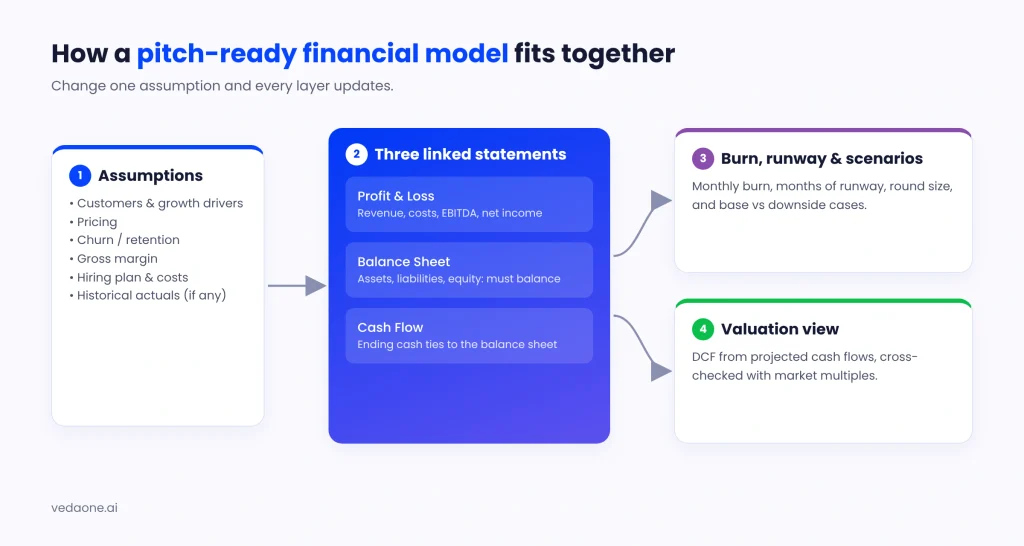
A pitch-ready model has four layers. Skip one and the others stop making sense.
| Layer | What it shows | The question it answers |
|---|---|---|
| Assumptions | Customers, pricing, conversion, churn, salaries, key costs | “Where do these numbers come from?” |
| Three financial statements | P&L, balance sheet, cash flow, all linked | “Is this business profitable, solvent and liquid?” |
| Funding and runway | Monthly burn, cash balance, months of runway, use of funds | “How long does this round last, and what does it buy?” |
| Scenarios and valuation | Base, best and downside cases; a valuation range | “What if you’re wrong, and what’s the business worth?” |
If the three statements feel unfamiliar, our guide on why your P&L and bank balance can disagree is a good primer before you start.
How to build a 3- or 5-year financial model, step by step
Step 1: Write down your assumptions first
Every number in your model should trace back to an assumption you can defend in one sentence. Keep them in one place, separate from the calculations, so you (and investors) can change them and see what moves.
The assumptions that matter most at the early stage:
- Customer acquisition: how many new customers per month, and through which channels
- Pricing: average revenue per customer, and whether it changes over time
- Retention: monthly churn or repeat-purchase rate
- Gross margin: what it costs to deliver each unit of revenue
- Headcount: who you hire, when, and at what cost
Where you have real data (pilot customers, a waitlist, early sales), use it. Where you don’t, use industry benchmarks and say so.
Step 2: Build revenue bottom-up
“We’ll capture 1% of a $10 billion market” is the fastest way to lose credibility. Investors want to see revenue built from the things you control: customers multiplied by price, by period.
Here’s a simple illustrative example for a B2B SaaS startup charging $500 per customer per month:
| Year 1 | Year 2 | Year 3 | |
|---|---|---|---|
| Average paying customers | 40 | 120 | 300 |
| Revenue ($500 x 12 months) | $240,000 | $720,000 | $1,800,000 |
| Gross profit (75% margin) | $180,000 | $540,000 | $1,350,000 |
| Operating expenses | $900,000 | $1,300,000 | $1,600,000 |
| Operating profit (EBITDA) | -$720,000 | -$760,000 | -$250,000 |
Now the growth story has a mechanism. Revenue triples in Year 2 because the customer base triples, and you can explain how: a sales hire in Month 6, a channel partnership, a price that holds.
If you already have historical numbers, start from them. A forecast that grows from your actual run rate is far more convincing than one that starts from zero.
Step 3: Connect the P&L, balance sheet and cash flow
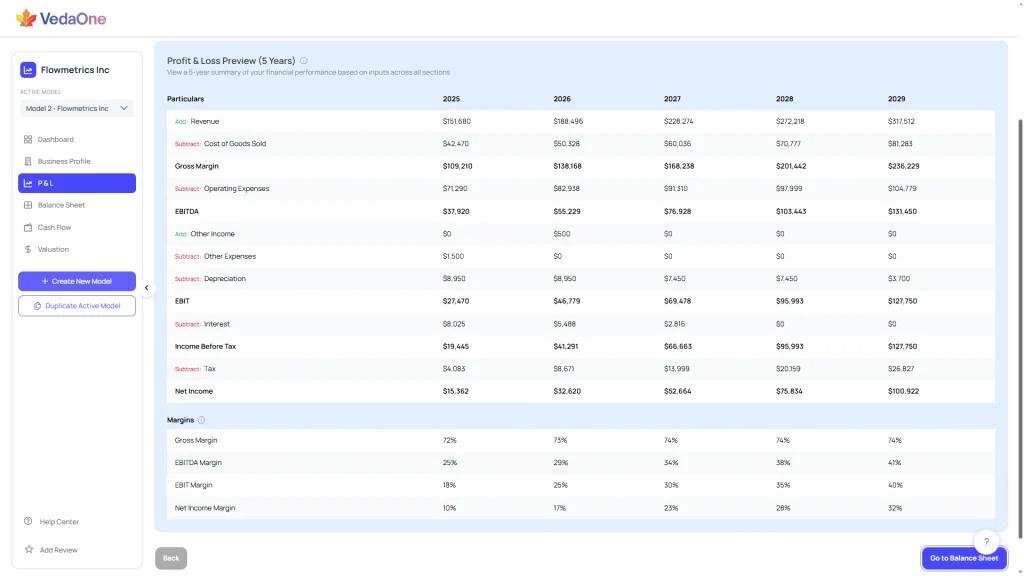
This is where most spreadsheet models break. Profit on the P&L doesn’t equal cash in the bank. Customers pay late, you buy equipment upfront, and loans get repaid. The balance sheet and cash flow statement capture all of that.
The checks investors (and you) should run:
- The balance sheet balances in every period.
- Ending cash on the cash flow statement matches cash on the balance sheet.
- Cash never goes negative without a funding event to cover it.
Building these links by hand is where hours disappear and formula errors creep in. Here’s what founders do when their Excel model stops working.
Step 4: Work out burn, runway and your round size
Burn rate is how much cash you spend each month beyond what comes in. Runway is how many months your cash lasts at that burn.
In the example above, the business burns $1.73 million across three years (using operating losses as a simple proxy for cash burn; a full model would also include working capital and equipment spend). A $2.5 million raise covers that and leaves a cushion of about $770,000.
That cushion matters. Carta recommends planning 18 to 24 months of cash burn before raising new capital, and its data shows the median gap between funding rounds now exceeds two years at every stage from seed to Series C. Plan for the next round to take longer than you’d like.
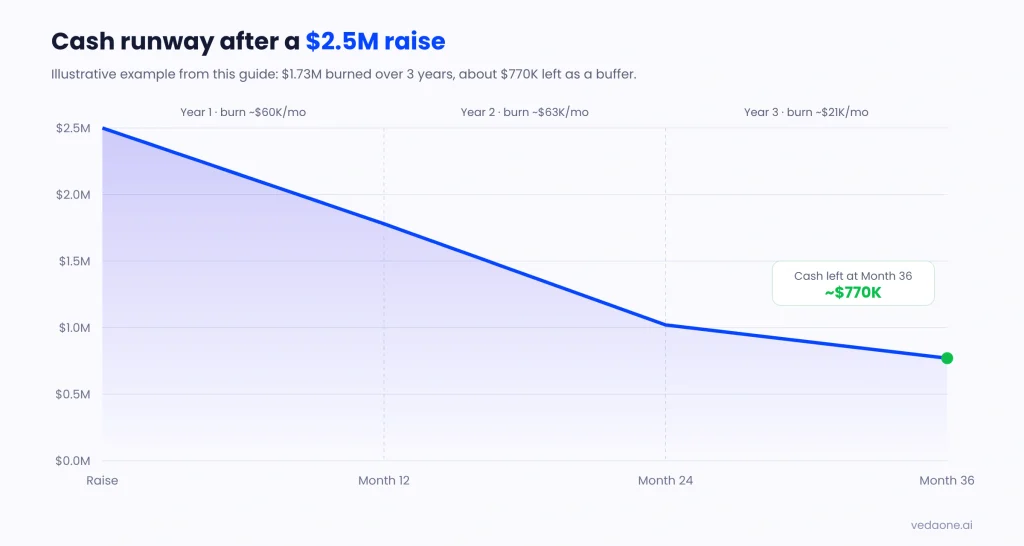
Then tie the raise to milestones: “This $2.5 million gets us to 300 customers and $1.8 million in revenue, which is the traction we need for a Series A.”
Step 5: Add scenarios
Investors know your base case is optimistic. Show them you know it too. At minimum, include:
- Base case: your realistic plan
- Downside case: slower customer growth, higher churn, a delayed hire paying off later
- Best case: optional, but useful for showing what extra capital could accelerate
The most useful question your downside case answers: “Do we still reach the next milestone before the cash runs out?”
Step 6: Add a valuation view
Your projections feed directly into what the business might be worth. A DCF uses your forecast cash flows; a market-multiples approach compares you to similar companies. They often give different answers, and here’s why both numbers can be right.
You don’t need to lead with valuation in the pitch, but knowing your range before the conversation helps you negotiate. For a quick first estimate, try VedaOne’s free AI Valuation Tool.
What should go on the financial projections slide?
The full model lives in your data room. The pitch slide is a summary. Keep it to one slide at seed:
- A revenue chart for 3 years (or 5 at Series A)
- Gross margin and operating profit or loss by year
- Monthly burn and runway after the raise
- Two or three key assumptions in plain words, such as “$500 average monthly price, 3% monthly churn”
- The milestone the round gets you to
Want to know what happens after the deck lands? Here’s what investors actually check before they fund you.
Common mistakes that weaken a pitch financial model
- Hockey-stick growth with no driver. If revenue jumps, show the hire, channel or launch that causes it.
- Costs that don’t scale with revenue. Tripling customers usually means more support, more servers and more salespeople.
- No hiring plan. Salaries are usually the biggest cost line. Show who joins and when.
- Ignoring payment timing. Customers paying in 45 or 60 days can create a cash gap even when the P&L looks healthy.
- A round size with no runway logic. “We’re raising $2 million” needs “because it gives us 24 months to reach X.”
Building your pitch model without spreadsheets
The structure above works whether you build it in Excel or not. The difference is time, and how often you’ll need to rebuild it as assumptions change during fundraising.
VedaOne walks you through it step by step: business profile, then P&L, balance sheet and cash flow, then valuation and a dashboard. It produces 5-year projections with linked statements, AI-suggested assumptions you can review and change, scenario views, and DCF and market-multiple valuations.
The AI suggestions are a starting point, not a final answer. You should still review every assumption and be ready to defend it in the room, ideally with an advisor checking your numbers.
If you’re working on your first model, our complete guide to creating financial projections covers the fundamentals in more depth. Or see how VedaOne supports financial modeling for startups.
Ready to build yours? Start a free 14-day trial or request a free 1:1 demo and we’ll walk you through it.
Frequently asked questions
Most early-stage investors expect 3 years of projections at pre-seed and seed, and 5 years at Series A and beyond. Model the first 12 to 24 months monthly, since that’s the period your round funds. Years beyond that are usually shown annually.
Yes. A pre-revenue model is simpler, but it still shows how much you need to raise, how long the money lasts, and what milestones it reaches. Investors at this stage care more about your assumptions and logic than precise numbers.
Financial projections are the forecast numbers: revenue, costs, profit and cash over time. A financial model is the connected structure that produces them, linking assumptions to the P&L, balance sheet and cash flow so that changing one input updates everything else.
Keep it to one slide at seed stage: a revenue chart, margins, burn and runway, two or three key assumptions, and the milestone your round funds. Share the full model separately when investors ask for it during diligence.