
Financial projections show how your business may perform in the future based on expected revenue, costs, cash flow, and growth assumptions. They help you understand whether your business plan is financially practical before you hire, expand, raise funding, apply for a loan, or make a major decision.
In simple terms, financial projections turn your business plan into numbers.
They help answer questions like:
- Can we afford this next move?
- Will revenue cover future expenses?
- Will cash run out before money comes in?
- When can the business become profitable?
- How much funding may be needed?
- What assumptions are driving growth?
- What could the business be worth if the plan works?
The U.S. Small Business Administration includes financial projections as part of business planning and funding preparation, and notes that businesses seeking loans should be prepared with a business plan, expense sheet, and financial projections.
For many business owners, the problem is not knowing that projections matter. The problem is knowing how to create them without getting lost in spreadsheets, formulas, and finance jargon.
That is exactly where structured financial projection software and AI-assisted planning tools like VedaOne become useful.
Table of Contents
Quick Answer – How Do You Create Financial Projections?
To create financial projections, start with your business assumptions, forecast revenue, estimate direct costs and operating expenses, build a Profit & Loss projection, forecast cash flow, add a balance sheet projection, connect the three financial statements, and review different scenarios.
The process usually looks like this:
| Step | What You Do |
| 1 | Define business assumptions |
| 2 | Forecast revenue |
| 3 | Estimate direct costs |
| 4 | Add operating expenses |
| 5 | Build a P&L projection |
| 6 | Create a cash flow projection |
| 7 | Add a balance sheet projection |
| 8 | Connect the three statements |
| 9 | Build conservative, base, and optimistic scenarios |
| 10 | Review and update projections regularly |
The goal is not to predict the future perfectly. The goal is to understand what could happen before you commit money, time, or resources.
What Are Financial Projections?
Financial projections are estimates of your future financial performance.
They usually show how revenue, expenses, profit, cash flow, assets, liabilities, and funding needs may change over time.
A complete set of financial projections may include:
| Projection Type | What It Shows |
| Revenue forecast | How much money the business expects to earn |
| Expense forecast | What the business expects to spend |
| Profit & Loss projection | Whether the business may become profitable |
| Cash flow projection | Whether the business may have enough cash |
| Balance sheet projection | What the business may own, owe, and retain |
| Funding requirement | How much capital may be needed |
| Valuation inputs | What may influence the estimated value of the business |
Financial projections are not guaranteed. They are planning tools.
A strong projection explains the thinking behind the numbers. A weak projection only shows numbers without explaining where they came from.
Why Financial Projections Matter More Than Most Business Owners Realize
Many businesses do not struggle because the idea is bad. They struggle because the numbers were never thoroughly tested.
- A founder may assume growth will cover future expenses.
- A small business owner may hire too early.
- A freelancer may increase revenue but still run into cash pressure.
- A startup may prepare for funding without knowing what its projections actually say.
- A growing business may look profitable on paper but still not have enough cash to operate.
Financial projections help prevent these problems by making the financial impact of decisions visible earlier.
They help you understand:
| Business Decision | What Financial Projections Help You Check |
| Hiring | Can payroll be supported by future revenue and cash flow? |
| Marketing spend | Will the expected return justify the added cost? |
| Expansion | Will growth improve profit or stretch cash too thin? |
| Pricing changes | How will prices affect revenue, margin, and customer volume? |
| Loan application | Can the business repay debt from future cash flow? |
| Fundraising | Are revenue, cost, and valuation assumptions realistic? |
| New product launch | How much investment is needed before revenue starts? |
This is why financial projections are not only for investors. They are for anyone running a business who wants to make decisions with better visibility.
Financial Projections vs Financial Model: What Is the Difference?
Financial projections are the future numbers you expect.
A financial model is the structure that creates those numbers.
For example:
| Term | Meaning |
| Financial projections | Expected revenue, expenses, profit, cash flow, and financial position |
| Financial model | The connected logic, assumptions, and calculations used to create projections |
A spreadsheet can be used to build a financial model, but the spreadsheet itself is not the strategy. The real value comes from the assumptions, connections, and scenarios inside the model. For startups that need to connect revenue assumptions, expenses, cash flow, and funding requirements,financial modeling software can help turn these inputs into structured financial projections.
Step 1: Start With Business Assumptions
Every financial projection begins with assumptions.
Assumptions are the numbers you believe are reasonable based on your pricing, customers, costs, market, and business plan.
Examples include:
| Assumption | Example |
| Average selling price | $100 per customer |
| Monthly customers | 250 |
| Monthly customer growth | 5% |
| Monthly marketing spend | $3,000 |
| Payroll cost | $12,000 per month |
| Software and tools | $1,000 per month |
| Customer payment period | 30 days |
| Rent and admin costs | $4,000 per month |
These assumptions do not need to be perfect, but they need to be realistic.
A projection built on unrealistic assumptions may look impressive, but it will not help you make better decisions.
Before building projections, ask:
- What do we sell?
- How do we price it?
- How many customers can we realistically serve?
- What does it cost to deliver the product or service?
- Which costs stay fixed?
- Which costs grow with sales?
- When do customers pay us?
- When do we need to pay employees, suppliers, lenders, or vendors?
This is where AI-powered financial planning can help. Instead of starting with a blank spreadsheet, VedaOne guides users through business inputs and AI-assisted assumptions to build structured financial projections. VedaOne guides users step by step – starting with revenue and cost assumptions, including drivers and growth rate % or %age of revenue assumptions, moving through P&L, cash flow, and balance sheet, and ending in valuation, key profitability metrics, and real-time insights. At each step, the AI suggests benchmarked assumptions tailored to the user’s industry, business model, size, and location; which the user can accept or override with their own inputs.
The user can then review and adjust those assumptions before generating projections.
Step 2: Forecast Revenue
Revenue is usually the first major section of a financial projection because many other numbers depend on it.
A common mistake is starting with a large target, such as:
“We want to make $1 million next year.”
That may be a goal, but it is not a proper projection.
A better approach is to build revenue from business drivers.
| Business Type | Revenue Formula |
| SaaS business | Subscribers × monthly subscription price |
| Consulting business | Projects × average project fee |
| Agency | Clients × monthly retainer |
| Retail business | Units sold × average selling price |
| Freelancer | Billable hours × hourly rate |
| Course creator | Students × course price |
Example Revenue Forecast
| Input | Value |
| Monthly customers | 200 |
| Average selling price | $100 |
| Monthly revenue | $20,000 |
| Annual revenue | $240,000 |
This approach is stronger because it explains how revenue will be generated.
It also makes the forecast easier to update. If pricing, customer volume, or growth slows, the projection can be adjusted.
This is important because business planning is not static. Your model should change when your business changes.
Step 3: Estimate Direct Costs
Direct costs are the costs directly linked to delivering your product or service.
They may include:
| Business Type | Possible Direct Costs |
| SaaS | Hosting, customer support, payment processing |
| Retail | Product cost, packaging, shipping |
| Consulting | Contractor fees, project delivery costs |
| Agency | Freelancers, tools used for client delivery |
| Education business | Platform fees, instructor fees, learning material costs |
Direct costs help calculate gross profit.
Simple Gross Profit Example
| Item | Amount |
| Monthly revenue | $20,000 |
| Direct costs | $6,000 |
| Gross profit | $14,000 |
| Gross margin | 70% |
This matters because revenue alone can be misleading.
A business with high revenue and high delivery costs may not be as strong as it appears. A business with moderate revenue and healthy margins may have better financial potential.
Step 4: Add Operating Expenses
Operating expenses are the regular costs needed to run the business.
These are different from direct costs.
Common operating expenses include:
| Expense Type | Examples |
| Payroll | Salaries, benefits, contractors |
| Marketing | Ads, content, agencies, tools |
| Software | CRM, accounting tools, subscriptions |
| Admin | Legal, accounting, insurance |
| Rent and utilities | Office, workspace, internet |
| Professional services | Advisors, consultants, bookkeeping |
| Travel | Events, meetings, client visits |
It is also useful to separate fixed costs and variable costs.
| Fixed Costs | Variable Costs |
| Rent | Payment processing fees |
| Base salaries | Shipping |
| Insurance | Sales commissions |
| Accounting fees | Customer support |
| Software subscriptions | Marketing linked to sales growth |
The SBA’s startup cost guidance also emphasizes calculating costs, so businesses can request funding, attract investors, and estimate when they may turn profitable.
This is where many projections become too optimistic. Business owners often remember the obvious expenses but forget the smaller costs that increase with growth.
Step 5: Build a Profit & Loss Projection
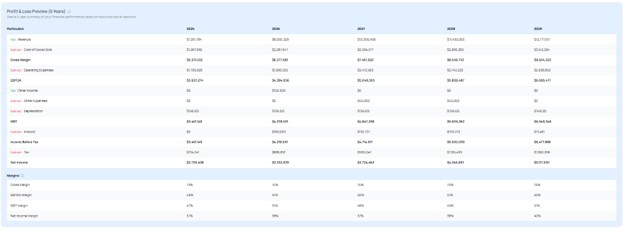
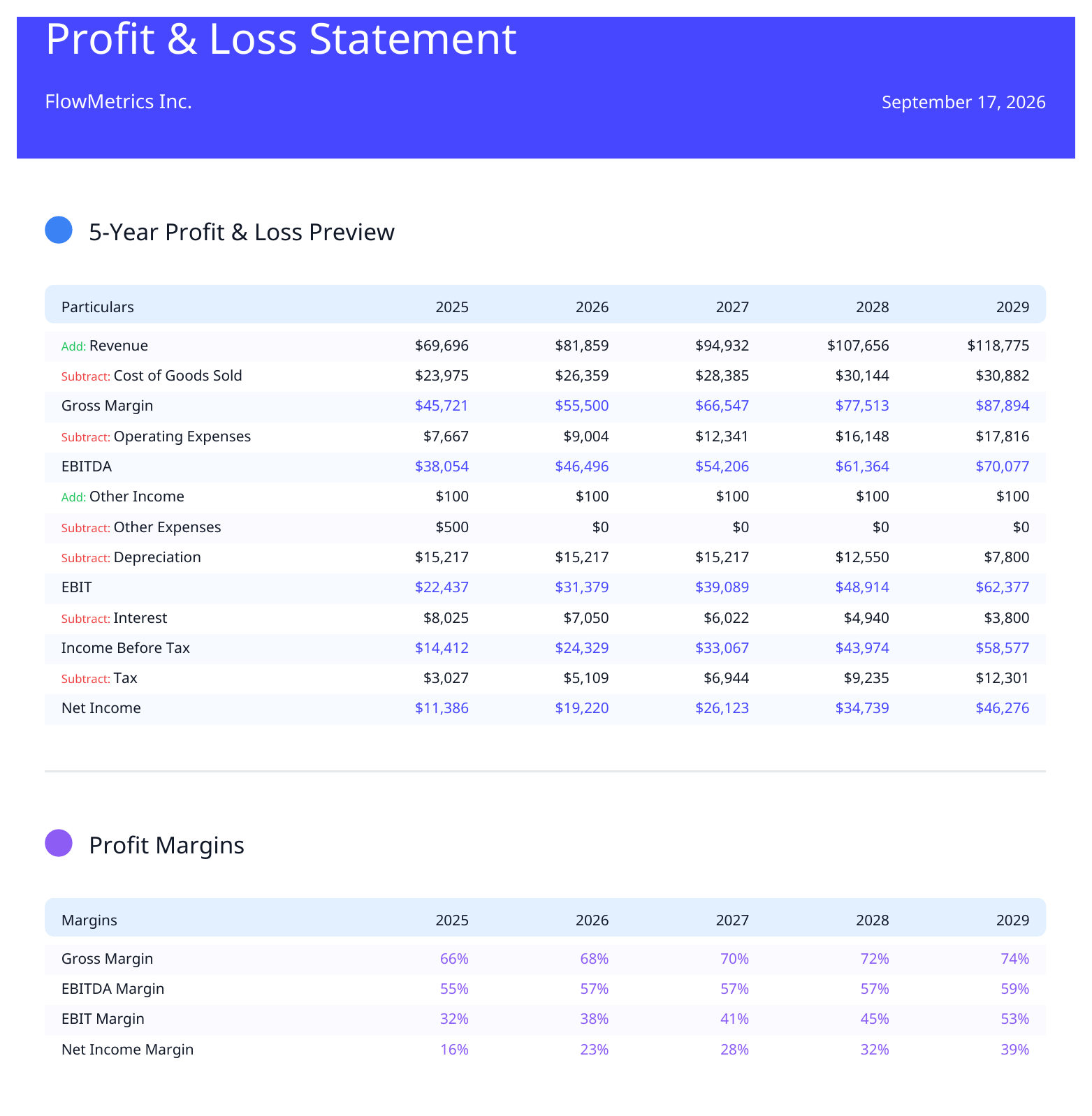
A Profit & Loss statement, also called a P&L or income statement, shows whether the business is expected to make a profit.
A basic P&L projection includes:
| Section | Meaning |
| Revenue | Money earned from sales |
| Direct costs | Cost of delivering the product or service |
| Gross profit | Revenue minus direct costs |
| Operating expenses | Cost of running the business |
| Net profit | Profit after expenses |
Simple P&L Projection
| Item | Monthly Amount |
| Revenue | $20,000 |
| Direct costs | $6,000 |
| Gross profit | $14,000 |
| Operating expenses | $10,000 |
| Net profit | $4,000 |
The P&L helps you understand profitability. But profitability is only one part of the picture. For growing businesses, financial planning for small businesses involves looking beyond profitability to understand how revenue, expenses, and cash flow affect everyday decisions.
A business can be profitable on paper and still struggle with cash if customers pay late; expenses are due early, or growth requires upfront spending.
That is why the next step is cash flow forecasting.
Step 6: Create a Cash Flow Projection
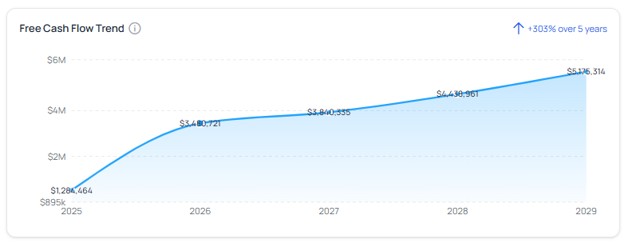
A cash flow projection shows when money is expected to enter and leave the business.
This is different from profit.
For example, a business may issue an invoice in January and record revenue in January. But if the customer pays in March, the cash does not arrive until March.
That timing gap can create pressure.
A cash flow projection helps you understand:
- when cash enters the business
- when expenses must be paid
- whether there may be a cash shortage
- whether the business can afford hiring or expansion
- how much runway the business has
- whether funding may be needed
The SBA’s finance management guidance explains that managing finances includes tracking capital and providing cash flow projections for future years.
Simple Cash Flow Projection
| Month | Cash In | Cash Out | Ending Cash |
| January | $20,000 | $18,000 | $12,000 |
| February | $15,000 | $22,000 | $5,000 |
| March | $28,000 | $20,000 | $13,000 |
Cash flow is where many business owners feel the real pressure.
Revenue may look strong. Profits may look positive. But if cash is not available when payments are due, the business can still run into trouble.
This is one of the strongest reasons to use financial projection software instead of only relying on static spreadsheets.
Step 7: Add a Balance Sheet Projection
A balance sheet shows what the business owns, what it owes, and what remains as equity.
It usually includes:
| Balance Sheet Area | Examples |
| Assets | Cash, inventory, equipment, receivables |
| Liabilities | Loans, credit cards, unpaid bills |
| Equity | Owner investment, retained earnings |
A balance sheet projection helps show the financial position of the business over time.
This matters because business health is not only about revenue.
- A business may grow revenue but also increase debt.
- A business may show profit but have weak cash reserves.
- A business may have strong sales but too many unpaid invoices.
- A business may look stable but have liabilities that reduce future flexibility.
The balance sheet helps complete the picture.
Step 8: Connect P&L, Cash Flow, and Balance Sheet
Strong financial projections connect the P&L, cash flow statement, and balance sheet.
These should not be treated as separate documents.
| Statement | Key Question |
| P&L | Is the business profitable? |
| Cash flow statement | Will the business have enough cash? |
| Balance sheet | What does the business own, owe, and retain? |
Corporate Finance Institute explains that a three-statement model links the income statement, balance sheet, and cash flow statement into one dynamic financial model used to forecast future results.
For example:
If you hire an employee, payroll expenses increase in the P&L. Cash reduces when salary is paid. Retained earnings may also change in the balance sheet.
If you take a loan, cash increases first. The loan appears as a liability. Later, repayments affect cash flow.
If customers pay late, revenue may appear in the P&L, but cash flow may still be weak.
This is why VedaOne’s connected projection approach matters. It is not just about creating one revenue forecast. It helps users generate structured financial outputs across P&L, cash flow, balance sheet, valuation estimates, and reports from connected business inputs.
Step 9: Build Different Scenarios
One projection is rarely enough.
Business rarely moves exactly according to plan. Sales may be slower. Costs may rise. Customers may delay payments. Funding may take longer. Growth may happen faster than expected.
Instead of building only one forecast, create multiple scenarios.
| Scenario | What It Shows |
| Conservative case | What happens if growth is slower or costs are higher |
| Base case | What is based on current assumptions |
| Optimistic case | What happens if growth is stronger than expected |
Scenario planning helps answer practical questions:
- What if revenue is 20% lower than expected?
- What if marketing costs increase?
- What if a major customer pays late?
- What if hiring happens earlier than planned?
- What if funding is delayed?
- What if pricing changes?
- What if expenses grow faster than revenue?
This is where projections become useful for real decision-making.
The point is not to create the most attractive version of the future. The point is to understand how resilient the business is under different conditions.
Step 10: Review and Update Projections Regularly
Financial projections should not be created once and forgotten.
They should be updated when:
- revenue changes
- costs increase
- pricing changes
- hiring plans change
- funding is received
- loan repayments begin
- customers pay later than expected
- the business enters a new market
- actual results differ from projections
A projection that is never updated becomes outdated quickly.
This is one of the biggest weaknesses of spreadsheet-based planning. A spreadsheet may work at the beginning, but as assumptions change, it becomes harder to maintain, harder to explain, and easier to break.
VedaOne is built to reduce that friction. Users can work with structured inputs, AI-assisted assumptions, connected projections, valuation estimates, and downloadable reports without constantly rebuilding formulas from scratch. VedaOne gets real-time market inputs that resets every 3 months to account for any major or minor change in the market.
Financial Projections Example – Simple 3-Year View
Here is a simplified example of a high-level projection.
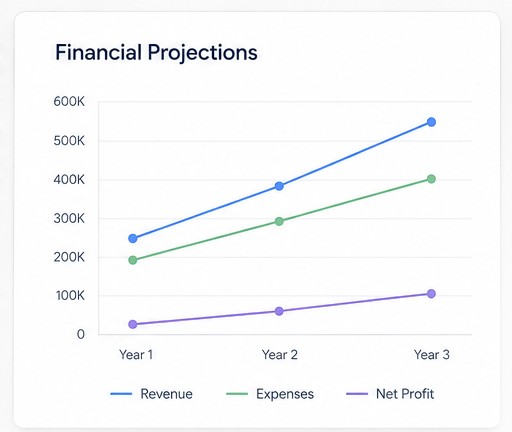
| Year | Revenue | Expenses | Net Profit | Ending Cash |
| Year 1 | $250,000 | $220,000 | $30,000 | $40,000 |
| Year 2 | $375,000 | $315,000 | $60,000 | $85,000 |
| Year 3 | $525,000 | $420,000 | $105,000 | $160,000 |
This table is useful, but it is not enough on its own.
A strong financial projection should also explain:
- what drives revenue growth
- which costs increase as the business grows
- when cash enters and leaves the business
- what assumptions support the numbers
- what could change the outcome
- whether the business may need funding
- how projections affect valuation
Financial projections also provide important inputs for estimating business value. Business valuation software can use projected revenue, profitability, cash flow, and growth assumptions to help business owners understand what their company may be worth. Without assumptions, projections are just numbers. With assumptions, they become a planning tool.
Common Financial Projection Mistakes to Avoid
Financial projections become unreliable when the structure is weak, or assumptions are unrealistic.
| Mistake | Why It Creates a Problem |
| Starting with a big revenue target | It does not explain how revenue will be generated |
| Ignoring cash flow | Profit does not always mean available cash |
| Underestimating expenses | The business may look healthier than it is |
| Using only one forecast | It does not show downside risk |
| Not updating assumptions | The projection becomes outdated |
| Treating valuation as exact | Valuation should be treated as an estimate |
| Depending only on static spreadsheets | Updates can become slow and error-prone |
| Making the model too complex | It becomes difficult to use and explain |
Good projections are not always the most complicated. They are the ones that help business owners understand what is happening and what could happen next.
Can You Create Financial Projections Without an Accountant?
Yes, you can create basic financial projections without an accountant if you understand your revenue, costs, cash flow, and assumptions.
However, accountants, CPAs, financial advisors, or tax professionals may still be needed for tax planning, compliance, audit, complex accounting treatment, or high-stakes decisions.
The challenge for many business owners is not accounting knowledge. It is a structure.
They need a guided way to connect:
- revenue assumptions
- expense assumptions
- P&L projections
- cash flow projections
- balance sheet projections
- valuation inputs
- funding needs
- business reports
This is where an AI financial projections tool can help.
VedaOne does not replace professional judgment. It gives business owners a clearer way to structure the numbers before they speak with investors, lenders, advisors, or internal teams.
How AI Helps with Financial Projections
AI can help simplify financial projections by reducing the blank-page problem.
Instead of starting with an empty spreadsheet, users can enter business details and work with AI-assisted assumptions that they can review and adjust.
An AI-assisted financial projection tool can help with:
| Area | How AI Can Help |
| Revenue assumptions | Suggest revenue drivers based on the business model |
| Cost assumptions | Help identify fixed and variable costs |
| Scenario planning | Compare conservative, base, and optimistic cases |
| Financial statements | Generate structured P&L, cash flow, and balance sheet views |
| Valuation inputs | Support valuation estimates |
| Plain-English explanations | Help users understand what changed and why |
The crucial point is control.
AI should not make the final business decision. It should help the user understand the numbers faster, review assumptions clearly, and make more informed decisions.
That is the difference between a generic AI response and a structured financial planning platform.
How VedaOne Is Different from Spreadsheets and Generic AI Tools
Many business owners start with spreadsheets because they are familiar and flexible. But as the business grows, spreadsheets can become difficult to maintain.
One change in market dynamics or industry trend movements and revenue, hiring, pricing, or cost assumptions may require manual updates across multiple sheets. Spreadsheets also require financial expertise to be built and maintained. If formulas break or assumptions become outdated, the numbers may look correct even when they are not reliable.
Generic AI tools can explain financial concepts, but they usually do not create a structured, connected financial planning workflow by themselves.
VedaOne is different because it is built specifically for business financial planning and valuation.
| Approach | What It Does Well | Where It Can Fall Short |
| Spreadsheet | Flexible and familiar | Manual, formula-heavy, difficult to maintain real-time assumptions change. Needs finance expertise |
| Generic AI tool | Useful for explanations and rough guidance | Not a connected financial planning system |
| Consultant-led model | Useful for complex or high-stakes planning | Can be expensive, slower, and less flexible for regular updates |
| VedaOne | AI-assisted financial projections – Profit & Loss, Balance sheet and cash flow statements, valuation estimates, and reports in one guided workflow | Users should still confirm assumptions and seek expert advice for high-stakes decisions |
VedaOne helps users move from scattered planning to connected financial clarity.
It supports:
- financial projections – Profit & Loss and Assets, Liabilities and Capital
- cash flow forecasting
- valuation estimates
- scenario planning
- AI-assisted assumptions
- downloadable reports
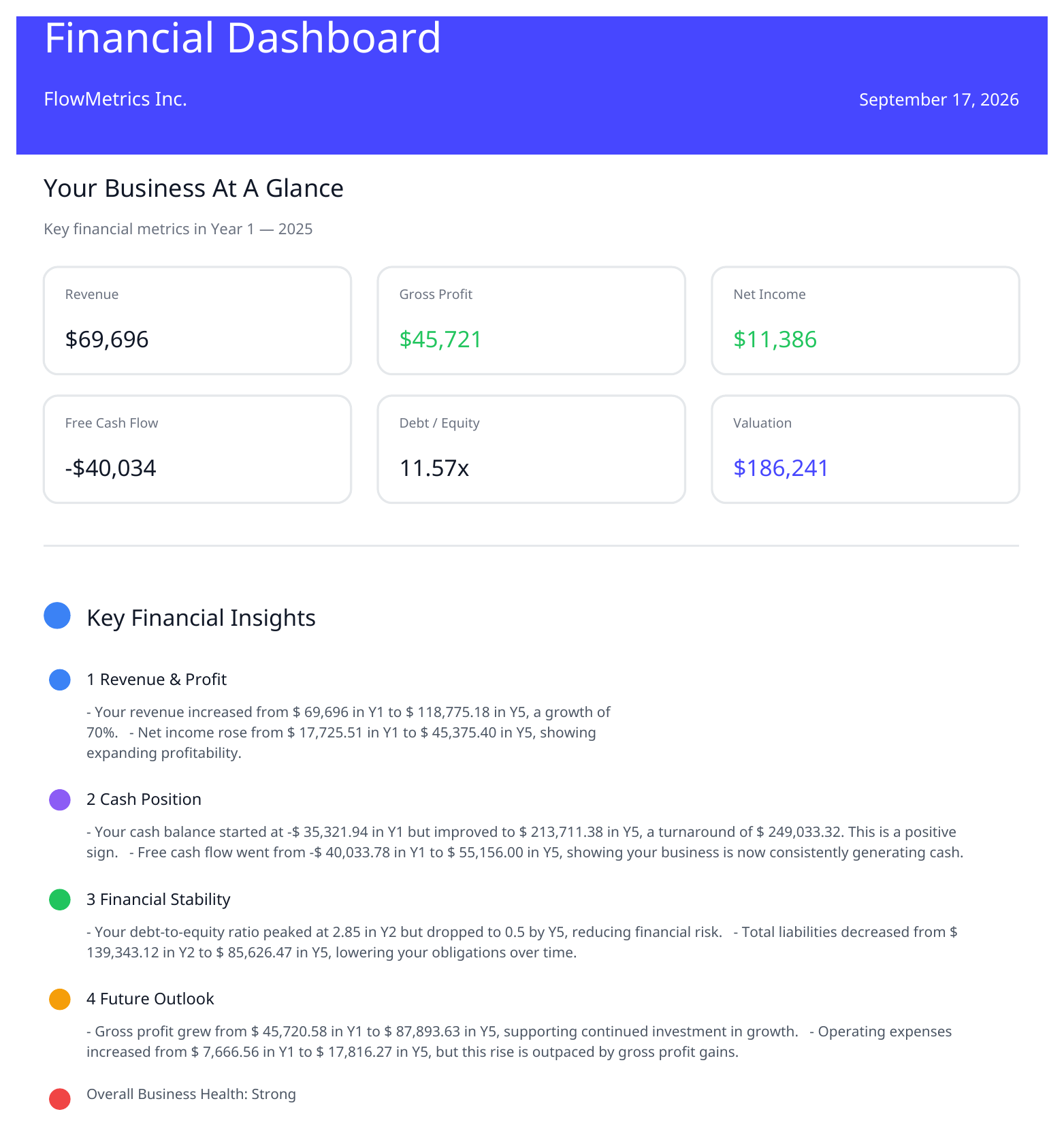
- business dashboards
- plain-English financial insights
This makes it useful for business planning, fundraising preparation, loan discussions, valuation estimates, and growth decisions.
How VedaOne Helps Create Financial Projections
VedaOne helps users create financial projections, forecast cash flow, generate financial statements, and estimate business value using AI-assisted planning.
Instead of starting from a blank spreadsheet, users enter key business details such as:
- Industry
- Location (city, state, county)
- business model
- Business size
- Currency
And VedaOne generate user-reviewable assumptions for
- Revenue streams
- Cost structure
- Growth assumptions
- Cost as a percentage % of revenue assumptions
- Fixed Asset assumptions by each operating year
- Receivables, Payables and Inventory calculations
The platform connects those inputs into structured financial outputs, including:
- Profit & Loss projections
- balance sheet projections
- cash flow projections
- valuation estimates
- business planning reports
- financial dashboards
This helps business owners understand what the numbers may mean before they make decisions.
VedaOne does not promise perfect predictions. It helps create a clearer, faster, and more structured way to plan.
When Should You Create Financial Projections?
You should create or update financial projections when:
- starting a business
- writing a business plan
- raising funding
- applying for a loan
- planning hiring
- expanding into a new market
- launching a new product
- changing pricing
- reviewing cash flow
- estimating business value
- preparing investor-ready financials
The SBA notes that funding preparation may require financial projections, and business planning resources often treat projections as part of explaining the financial story of the business.
If the decision effects money, projections can help you understand the impact before acting.
Quick Summary
Financial projections help you estimate how your business may perform in the future.
To create them, start with clear assumptions, forecast revenue, estimate direct costs and operating expenses, build a P&L, forecast cash flow, add a balance sheet, connect the three financial statements, and review multiple scenarios.
The best projections are not perfect predictions. They are practical planning tools.
For businesses that do not want to build complex spreadsheets manually, VedaOne provides an AI-assisted way to create structured projections, cash flow forecasts, financial statements, valuation estimates, and business reports from connected inputs.
That makes planning faster, clearer, and easier to update.
Disclaimer:
This article is for educational purposes only. Financial projections are estimates based on assumptions. They should not be treated as guaranteed outcomes or as financial, tax, investment, or accounting advice. For high-stakes decisions, businesses should consult a qualified finance, accounting, or tax professional.
Frequently Asked Questions
Financial projections are estimates of a business’s future revenue, expenses, profit, cash flow, and financial position. They help business owners understand how the business may perform under different assumptions.
To create financial projections, start with business assumptions, forecast revenue, estimate costs, build a P&L, create a cash flow forecast, add a balance sheet, and review multiple scenarios. The projections should be updated as actual performance changes.
Financial projections should include revenue forecasts, expense forecasts, P&L projections, cash flow projections, balance sheet projections, funding needs, and the assumptions behind the numbers.
No. Financial projections are the future numbers you expect. A financial model is the structure that connects assumptions, calculations, and financial statements to create those projections.
Financial projections show whether a business plan is financially practical. They help explain expected revenue, costs, profitability, cash flow, funding needs, and growth assumptions.
Yes. You can create basic financial projections without an accountant if you understand your revenue, costs, cash flow, and assumptions. However, professional review may still be needed for tax, compliance, accounting, or high-stakes financial decisions.
Many businesses start with 12-month projections for internal planning. For funding, lending, or investor discussions, businesses often prepare three-year or five-year projections.
Profits show whether revenue is higher than expenses. Cash flow shows when money enters and leaves the business. A business can be profitable on paper but still face cash pressure if customers pay late or expenses are due earlier.
AI can help create financial projections by suggesting assumptions, organizing business inputs, generating structured financial statements, and explaining outputs. Users should still review and adjust assumptions before making decisions.
VedaOne helps users create AI-assisted financial projections, forecast cash flow, generate P&L, cash flow and balance sheet projections, estimate business value, and produce financial planning reports without starting from a blank spreadsheet. It gets ready for real-time market data and feeds the assumptions – revenue and cost drivers, growth rates, operating costs as a percentage of revenue, fixed asset suggestions, receivables, payables, and inventory assumptions, amongst others.