
Most business owners eventually ask the same question – how much is my business worth?
The answer is rarely one fixed number. Business valuation depends on revenue, profit, cash flow, assets, liabilities, growth, risk, industry conditions, and the method used to calculate value.
That is why two businesses with the same revenue can have very different valuations. One may have strong margins, repeat customers, predictable cash flow, and low debt. The other may have high sales but weak profit, late payments, heavy liabilities, or unstable demand.
A business valuation is not just about what the business earned last year. It is about what the business may be able to generate in the future.
Table of Contents
What Is Business Valuation?

Business valuation is the process of estimating the economic value of a business based on factors such as revenue, profitability, cash flow, assets, liabilities, growth expectations and risk.
It may be used when raising funding, selling a business, applying for a loan, planning a merger, bringing in a partner, or simply understanding where the business stands.
The U.S. Small Business Administration explains that valuation can help set a monetary value before marketing a business to prospective buyers. It also lists asset-based valuation as one common approach for small businesses. For founders and growing businesses, valuation is also useful before investor conversations. It helps connect the business story with numbers: revenue, margins, cash flow, growth assumptions, and market opportunity.
Why Business Valuation Is Not Just a Revenue Multiple
A common mistake is assuming valuation is simply revenue multiplied by a standard number.
For example:
“Businesses in my industry sell for 3x revenue, so my business must be worth 3x revenue.”
That may be a starting point, but it is not enough.
A revenue multiple does not always show whether the business is profitable, cash-positive, scalable, or risky. Investopedia notes that the times-revenue method is simple, but it does not account for expenses or profitability.
This is why valuation needs context. A business with lower revenue, but stronger profit and predictable cash flow may be more valuable than a larger business with weak margins and high uncertainty.
Common Ways to Calculate Business Valuation
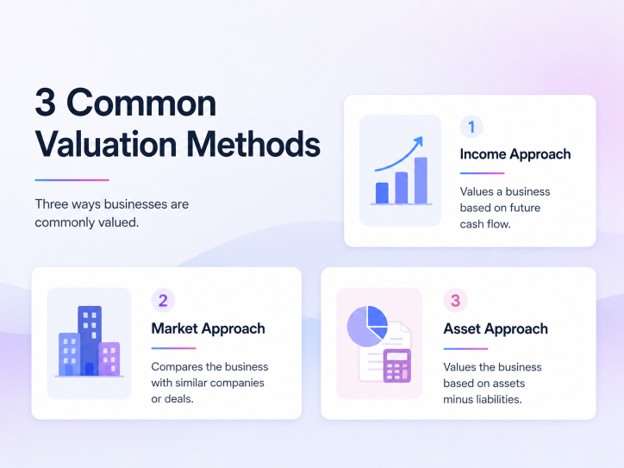
There are several valuation methods, but most fall into three broad approaches: income-based, market-based, and asset-based valuation. The IRS business valuation guidelines also refer to income, market, and asset-based approaches as generally accepted valuation approaches.
| Method | Best Used When |
| Income approach | The business has future cash flow that can be projected |
| Market approach | Similar businesses or transactions can be compared |
| Asset approach | The business has meaningful tangible assets |
| Startup methods | The business is early-stage or has limited revenue |
For established businesses, discounted cash flow and market multiples are commonly used. A market-multiple valuation can also provide a useful comparison against similar businesses or transactions. CFI explains that widely used business valuation methods include discounted cash flow analysis, comparable company analysis, and precedent transactions.
How to Calculate Business Valuation in Simple Steps
Start with clean financial information. You need revenue, expenses, profit, cash flow, assets, liabilities, and growth history. If the numbers are incomplete or outdated, the valuation will be weak.
Next, understand the purpose of the valuation. A valuation for fundraising may be different from a valuation for selling a business or applying for a loan. The purpose affects which method is most relevant.
Then choose the valuation method. A profitable business may use an income-based method such as discounted cash flow. A business in a market with strong comparable data, enough similar companies or recent deals to compare against, may use market multiples, which apply the revenue or earnings multiples seen in those comparable deals to its own numbers. A very early-stage startup may need startup valuation methods that rely more on assumptions, traction, team, product, and market potential.
After that, test the assumptions. Small changes in growth rate, margin, discount rate, or market multiple can change the valuation meaningfully. This is why business valuation should usually be shown as a range, not a single “perfect” number.
Finally, review the result against reality. Ask whether the valuation is supported by cash flow, growth, margins, assets, and market conditions.
How to Value a Startup With No Revenue

Valuing a startup with no revenue is harder because there is little or no financial history.
In this case, valuation depends more on forward-looking assumptions and qualitative factors such as:
- market size
- product stage
- team strength
- customer interest
- early traction
- intellectual property
- competitive advantage
- funding requirement
- expected growth
A startup valuation calculator can provide a helpful starting point, but the result should still be reviewed carefully. Early-stage valuation is especially assumption-heavy, so it is better to think in ranges rather than fixed numbers.
Where Spreadsheets and Simple Calculators Fall Short
A free business valuation tool or spreadsheet can be useful for a quick estimate. But the valuation is connected to many moving parts.
- Revenue affects projections.
- Expenses affect profit.
- Cash flow affects sustainability.
- Assets and liabilities affect financial position.
- Assumptions affect the final value.
If these parts are disconnected, the valuation may look clean but miss the real picture.
This is where business valuation software can be more useful than a static spreadsheet. The goal is not just to calculate a number. The goal is to understand what is driving that number.
How VedaOne Helps with Business Valuation
VedaOne helps users estimate business value as part of a connected financial planning workflow.
Instead of treating valuation as a standalone calculator, VedaOne runs a discounted cash flow (DCF) model alongside a market-multiples comparison, and connects both to financial projections, cash flow forecasting, P&L, balance sheet, assumptions, and business reports.
Users can enter business details such as industry, location, revenue streams, costs, growth assumptions, and operating inputs. VedaOne then helps generate user-reviewable assumptions and structured outputs, including valuation estimates, financial statements, projections, and scenario-based insights.
This makes it useful for business owners asking, “how much is my business worth?” and for founders preparing for funding conversations.
VedaOne is different from a generic AI answer or a basic calculator because it does not only explain valuation. It helps connect valuation to the financial model behind the business.
Final Takeaway
Business valuation is not about finding one perfect number. It is about understanding what the business may be worth based on its revenue, cash flow, assets, liabilities, growth, risk, and assumptions.
A good valuation should explain the method, show the assumptions, and make the value drivers clear.
For business owners and founders who do not want to rely only on static spreadsheets, VedaOne offers an AI-assisted way to connect valuation with projections, cash flow, financial statements, and planning reports in one place.
Disclaimer:
This article is for educational purposes only. Financial projections are estimates based on assumptions. They should not be treated as guaranteed outcomes or as financial, tax, investment, or accounting advice. For high-stakes decisions, businesses should consult a qualified finance, accounting, or tax professional.
Frequently Asked Questions
You calculate business valuation by reviewing revenue, profit, cash flow, assets, liabilities, growth, and risk, then applying a suitable valuation method such as income-based valuation, market multiples, or asset-based valuation.
The easiest way is to use a business valuation calculator, but the estimate should be reviewed carefully because valuation depends on assumptions, industry, cash flow, profitability, and market conditions.
Your business value depends on its revenue, profit, cash flow, assets, liabilities, growth potential, industry, and risk. Most valuations are better shown as a range rather than a fixed number.
A startup with no revenue is usually valued using assumptions about market size, team, product stage, early traction, funding needs, growth potential, and comparable startup deals.
VedaOne helps users estimate business value by running a discounted cash flow (DCF) model and a market-multiples comparison side by side, connected to financial projections, cash flow forecasts, P&L, balance sheet, assumptions, dashboards, and planning reports.