

A business can make sales, show profit, and still run short of cash.
That is why cash flow forecasting matters. It helps you see when money is expected to come in, when payments are due, and whether the business has enough cash to keep moving without last-minute pressure.
For small businesses, cash flow problems usually do not appear suddenly. They build quietly. A client pays late. A tax payment comes due. A software renewal hits the account. A new hire starts before the next big invoice is paid. On paper, the business may look fine. In the bank account, the pressure is real.
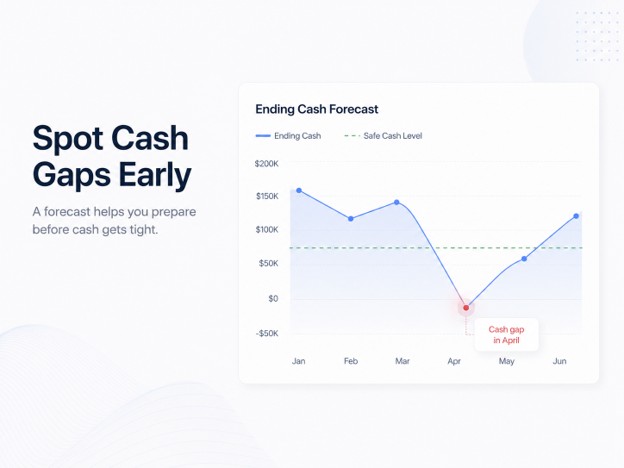
A cash flow forecast helps you see that pressure before it becomes urgent.
Table of Contents
What Is a Cash Flow Forecast?
A cash flow forecast is a simple view of expected money in and money out over a future period. It usually starts with the cash you already have, adds the money you expect to receive, subtracts the money you expect to spend, and shows what may be left.
In simple terms, it answers one question: Will the business have enough cash when it needs it?
This is different from profit. Profit tells you whether revenue is higher than expenses. Cash flow tells you whether money is actually available at the right time.
That difference matters. A business may invoice a client today, but if the payment arrives after 45 days, that cash cannot be used for payroll, rent, suppliers, or loan repayments today.
Why Small Businesses Need Cash Flow Forecasting
Most small business owners already have a sense of revenue. They know what they sold, what clients owe, and what work is expected next. The problem is that revenue alone does not show timing.
Cash flow forecasting helps business owners understand whether they can afford decisions such as hiring, increasing marketing spend, buying inventory, launching a new service, or waiting for delayed payments. When combined with broader financial forecasting, it can also help businesses evaluate how these decisions may affect revenue, expenses, cash balances and future funding needs..
It also helps answer practical questions:
- Can we cover next month’s expenses?
- Will one late payment create a cash gap?
- Can we hire now or should we wait?
- Do we need funding before expansion?
- Are we growing safely or stretching cash too thin?
This is why cash flow is not only an accounting topic. It is a business decision topic.
What Should Go Into a Cash Flow Forecast?
A useful forecast does not need to be complicated. It needs to be honest.
Start with your opening cash balance. Then list expected cash inflows, such as customer payments, subscriptions, retainers, product sales, loan receipts, owner contributions, or investor funding.
After that, list expected cash outflows. These usually include salaries, contractor payments, rent, software, marketing, supplier payments, taxes, loan repayments, insurance, and professional fees.
The important part is timing. A cash flow forecast should show when money is expected, not just whether money is expected.
For example, if a client invoice is worth $10,000 but the payment is expected next month, it should appear in next month’s cash inflow, not this month’s.
This is where many basic spreadsheets become unreliable. They may show revenue, but not the actual cash movement behind that revenue.
A Simple Cash Flow Forecast Example

Here is a simple way to think about it.
| Month | Cash In | Cash Out | Ending Cash |
| January | $25,000 | $20,000 | $15,000 |
| February | $18,000 | $24,000 | $9,000 |
| March | $30,000 | $22,000 | $17,000 |
In this example, February is the warning month. The business is still operating, but the ending cash balance drops. If the minimum safe cash level is $10,000, February becomes a risk.
That does not mean the business is failing. It means the owner has time to act. They may follow up on receivables, delay non-essential spending, adjust payment terms, or arrange short-term funding.
That is the real value of forecasting. It gives you time.
Where Spreadsheets Start Falling Short
A basic spreadsheet can be useful in the beginning. It gives structure and helps a business owner understand the basic flow of money.
But as the business grows, a static spreadsheet can become difficult to maintain.
One delayed payment can affect cash balance. One hiring decision can affect payroll, runway, profit, and funding needs. One pricing change can affect revenue, cash flow, and future valuation. If each change has to be manually updated across different sheets, mistakes become easier.
This is where cash flow forecasting software and connected financial modelling can become useful. Instead of maintaining separate spreadsheets for revenue, expenses, cash flow and valuation, businesses can work from a connected model where changes to one assumption can flow through the wider financial picture. The goal is not to make the business owner less involved. The goal is to make the numbers easier to update, review, and understand.
How AI Can Help With Cash Flow Forecasting
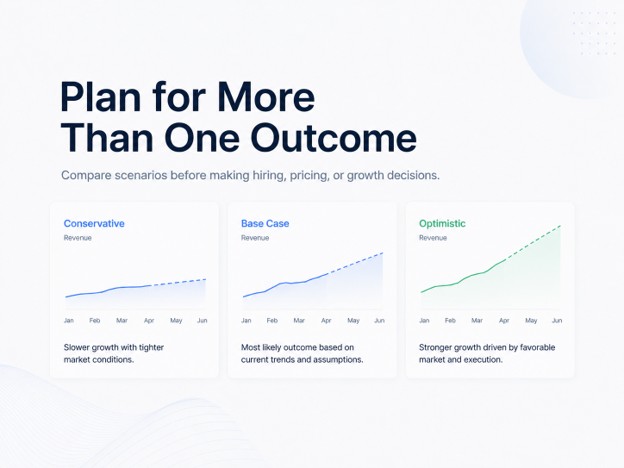
AI cash flow forecasting can help reduce the blank-page problem. Instead of asking business owners to build everything from scratch, an AI cash flow forecasting tool can help organize revenue assumptions, expense categories, payment timing, and scenario views.
AI should not make the final decision for the business. It should help the user see the numbers clearly, review assumptions, and understand what may happen if payments are delayed, costs increase, or revenue slows down.
Automated cash flow forecasting is most useful when it connects cash flow with the rest of the business model, instead of treating it as a separate table.
How VedaOne Helps
VedaOne helps businesses move beyond disconnected spreadsheets with connected financial projections, cash flow forecasting, P&L and balance-sheet modelling, and business valuation tools for growing businesses.
Users can enter business details such as revenue streams, cost structure, payment timing, growth assumptions, and operating expenses. VedaOne then helps create structured, user-reviewable financial outputs that show how money may move through the business.
This makes it useful for building a startup cash flow forecast, reviewing a startup cash flow projection, preparing for funding, planning growth, or understanding whether the business has enough runway for its next decision.
VedaOne is different because it does not only explain cash flow. It helps turn business inputs into connected financial planning outputs.
Final Takeaway
Cash flow forecasting helps small businesses see future cash pressure before it becomes a problem. It shows when money may come in, when money may go out, and whether the business can afford its next move.
Profit tells you whether the business model is working. Cash flow tells you whether the business can keep operating while that model plays out.
For business owners who do not want to rely on static spreadsheets, VedaOne offers a clearer way to forecast cash flow, review assumptions, and connect cash movement with wider financial planning. Because cash flow projections also influence business valuation, keeping the forecast connected to business valuation models can help founders understand how changes in revenue, margins, expenses and growth assumptions may affect the estimated value of the business.
Disclaimer:
This article is for educational purposes only. Financial projections are estimates based on assumptions. They should not be treated as guaranteed outcomes or as financial, tax, investment, or accounting advice. For high-stakes decisions, businesses should consult a qualified finance, accounting, or tax professional.
Frequently Asked Questions
A cash flow forecast estimates future money coming in and going out of a business. It helps show whether the business may have enough cash to cover expenses.
Cash flow forecasting is important because a business can be profitable but still face cash pressure if payments arrive late or expenses are due earlier.
Yes. AI can help organize assumptions, forecast cash movement, compare scenarios, and explain changes. Users should still review and adjust the assumptions.
VedaOne helps users create cash flow forecasts as part of connected financial projections, including P&L, balance sheet, valuation estimates, dashboards, and planning reports.