
“How much is my business worth?” sounds like a simple question. The cost of getting a reliable answer, however, can vary dramatically.
In 2026, a business owner may choose between a professional valuation, business valuation software, or a DIY approach using spreadsheets and publicly available information. The right option depends less on the size of the business and more on why you need the valuation.
Table of Contents
How Much Does a Business Valuation Cost?
There is no single standard price.
Published pricing for professional business valuations varies widely; and that range says more about what’s being priced than it does about a single “right” cost. A limited or basic engagement, built mainly for internal planning, generally sits toward the lower end. A comprehensive, specialist or litigation-grade valuation, the kind built to hold up to a lender, a court, or a tax authority, sits considerably higher, often by an order of magnitude.
This holds broadly true across markets, including the US and India: the purpose of the valuation and the level of outside scrutiny it needs to survive drive the cost far more than geography does. If you want an actual number to budget against, ask a professional for a quote against your specific purpose and complexity rather than relying on a published range – those vary enough by provider and year that a general figure risks being wrong either way.
Option 1: Hire a CA or Professional Valuation Expert
A professional valuation is usually the most expensive route, but it can be appropriate when the valuation needs to withstand external scrutiny.
A professional may analyze historical financials, forecasts, assets, liabilities, industry conditions, comparable companies and other business-specific factors. The report may also need to follow professional, tax, legal or regulatory requirements.
This makes professional valuation appropriate for situations such as:
- M&A transactions
- Shareholder disputes
- Tax or regulatory requirements
- Certain ESOP or equity transactions
- Formal financing or legal purposes
- Situations where an independent professional opinion is specifically required
The cost rises with the complexity of the business, the scope of the engagement, the required methodology, and the level of documentation or defensibility needed.
Best for: situations where you need a formal, independently prepared valuation.
Option 2: Use Business Valuation Software
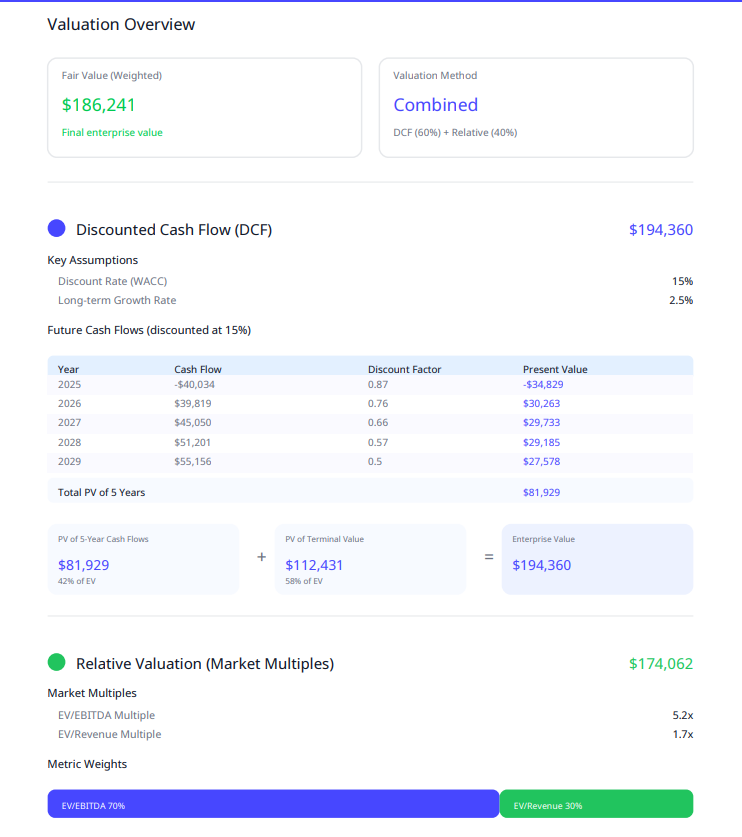
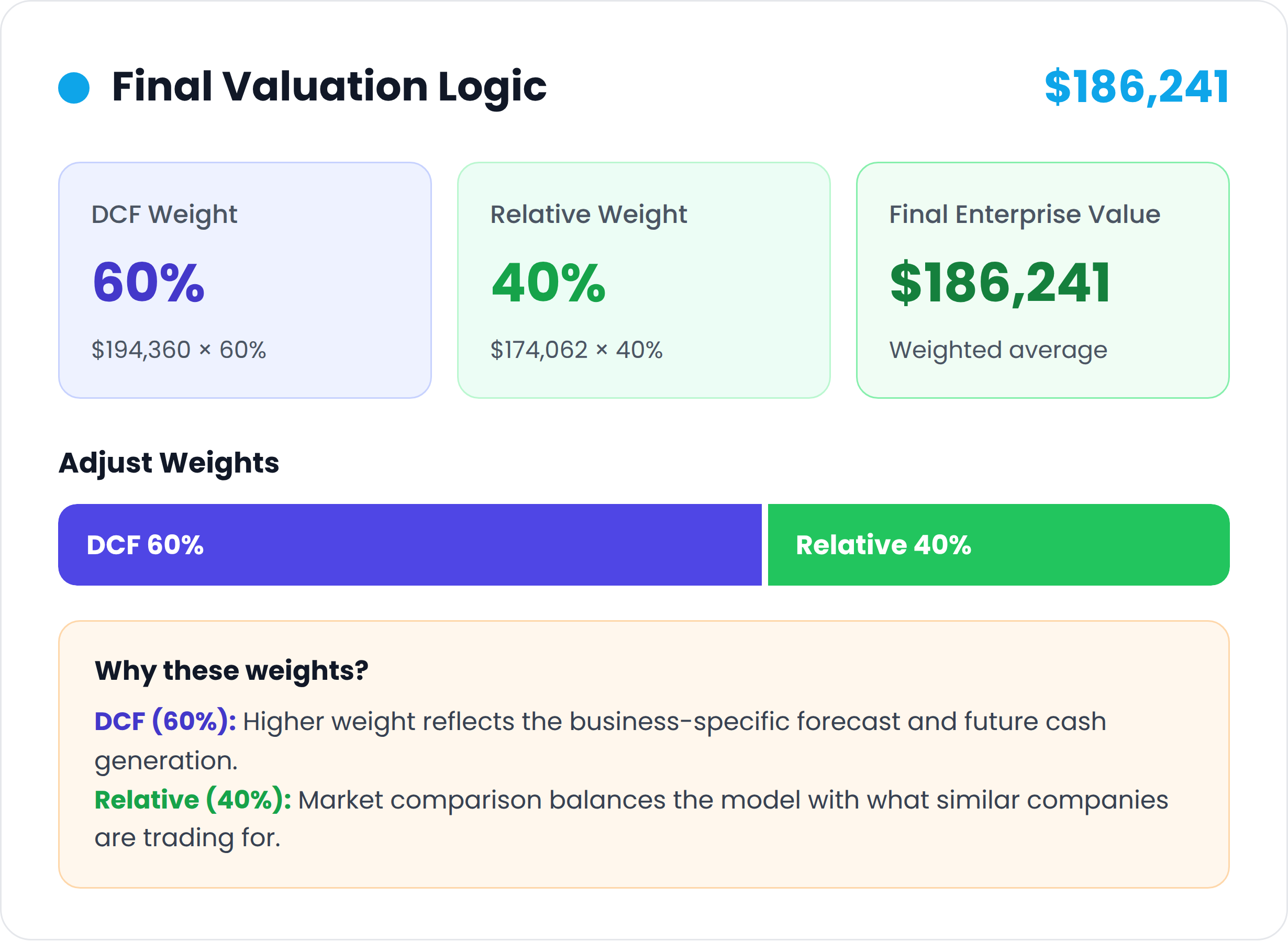
Business valuation software offers a different trade-off – lower cost, faster turnaround and greater control over the modelling process. VedaOne’s AI business valuation software helps business owners estimate their company’s value using financial projections, cash flow analysis, discounted cash flow (DCF), and relative valuation methods.
VedaOne takes an integrated approach. Instead of treating valuation as a standalone number, it connects financial projections with P&L, balance sheet and cash flow modelling, then applies DCF and relative valuation methods. Its valuation report also includes sensitivity analysis and AI-generated insights into what is driving the estimated value.
This can make software particularly useful when you want to understand your business value, test assumptions, prepare discussions, or evaluate different business decisions rather than obtain a formal certified valuation.
Best for: business planning, financial analysis, scenario testing, and preliminary valuation work.
Option 3: Do a DIY business valuation
A DIY valuation costs the least financially, but it requires the most learning and manual work.
You might use a spreadsheet to build projections, calculate discounted cash flow, research industry multiples, and compare similar businesses. For startups preparing financial projections or planning a fundraising round, financial modeling software can help connect revenue forecasts, operating expenses, cash flow, and valuation assumptions in one financial model.
If you want an initial estimate without building a financial model from scratch, you can use VedaOne’s free AI valuation tool. Enter your business details, revenue, and operating profit to generate an estimated business value based on market multiples.
The challenge is that the final number is only as good as the assumptions behind it.
For example, changing your growth rate, discount rate, or valuation multiple can materially change the result. VedaOne’s own valuation reports demonstrate this through sensitivity analysis, where different WACC and growth assumptions produce different estimated values.
Best for: learning how valuation works or creating an initial internal estimate.
So, Which Business Valuation Option Should You Choose?
| Your situation | Best starting point |
| I want to understand my business value | Business valuation software |
| I want to test different growth assumptions | Business valuation software |
| I am planning a fundraise | In practice, this usually plays out as – software to prepare your numbers, and professional review once you have a lead investor or term sheet. |
| I am considering selling my business | Software for an initial estimate; professional valuation/advisory when needed |
| I need a formal regulatory or legal valuation | Qualified valuation professional |
| I simply want to learn what my business could be worth | DIY or free valuation tool |
For small and medium business owners, understanding business value is often part of a broader financial planning process. Financial planning for small businesses can help owners review profitability, forecast cash flow, and understand how future decisions may influence business value.
The key is not to pay for a more rigorous valuation than your decision requires, but also not to use a quick software estimate when a formal independent valuation is legally or commercially necessary.
Is an AI Business Valuation Reliable?
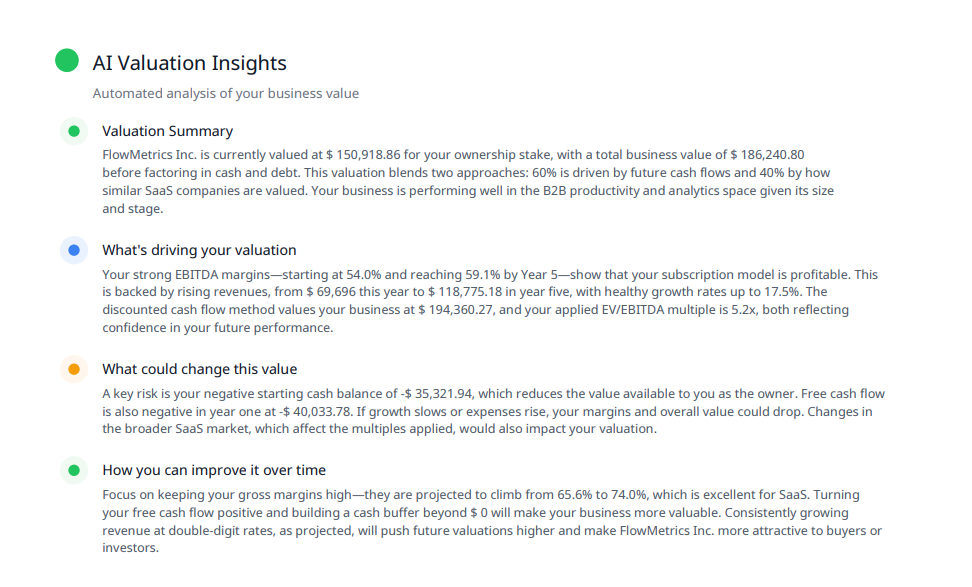
AI can make valuation easier, but the important question is what the AI is actually doing.
VedaOne uses AI to generate finance-specific assumptions such as revenue drivers, cost drivers, growth rates, and valuation inputs based on the user’s business context. Its AI-powered financial planning approach helps businesses connect these assumptions with financial projections, cash flow forecasts, and valuation estimates. Those assumptions can be reviewed and adjusted by the user. The actual financial modelling and valuation calculations are performed by VedaOne’s product logic.
That makes AI an assistant in the valuation workflow, rather than the sole source of the valuation result.
The Bottom Line
A business valuation can cost anywhere from very little to tens of thousands of dollars, depending on the purpose, complexity and level of professional assurance required.
For an owner trying to understand what the business may be worth, what is driving that value and how different assumptions could change it, business valuation software can be a practical first step.
For VedaOne users, valuation is connected to the broader financial model; so you can move from financial projections to business value, rather than treating valuation as a number separate from how the business operates.
Note: This piece is for general informational purposes only and isn’t financial, investment, tax or legal advice. Valuation costs and outcomes vary by jurisdiction, purpose, and the specifics of your business. For a number you’ll rely on in a regulated or high-stakes decision, fundraising, a sale, a tax filing, litigation, consult a licensed valuation professional, accountant or financial advisor before acting on it.
Frequently Asked Questions
The cost depends on the purpose and complexity of the valuation. A basic software-based estimate may cost little or nothing, while professional valuations can range from a few thousand dollars to tens of thousands for complex or specialist engagements. A formal valuation required for legal, tax or regulatory purposes may also involve additional professional fees.
A professional valuation can be worthwhile when you need an independent, defensible valuation for a transaction, regulatory requirement, shareholder matter or other formal purpose. For internal planning or an initial estimate of business value, software may be a more accessible starting point.
Generally, business valuation software costs less than commissioning a full professional valuation because the software automates parts of the modelling and analysis process. The two options serve different purposes, however, and software should not be treated as a substitute for a formal valuation when one is required.
Yes. You can build a DIY business valuation using financial projections, discounted cash flow analysis, market multiples, and comparable businesses. The challenge is ensuring that the assumptions, methodology, and data are appropriate for your business.
A DIY valuation or free business valuation calculator is usually the lowest cost option. However, the cheapest method is not necessarily the most suitable. The right approach depends on whether you need an initial estimate, business planning support, or a formal independent valuation.
A business valuation calculator typically provides an estimate based on inputs and predefined methodologies. A professional valuation involves deeper analysis and professional judgement and may be required when the valuation needs to meet legal, regulatory or transaction-specific standards.
Yes. AI can assist with generating financial assumptions, analyzing business information, and supporting valuation of workflows. VedaOne uses AI to generate finance-specific assumptions based on business context, while its financial modelling and valuation calculations are handled by its product logic.
An AI-assisted valuation should be treated as an estimate, not a guaranteed value. The result depends on the quality of the financial information, assumptions, valuation methodology, and inputs used. VedaOne allows users to review and adjust AI-generated assumptions before projections are finalised.
There is no single best method for every business. Discounted cash flow, market multiples, and other approaches can produce different perspectives on value. The appropriate method depends on the business model, available financial information, stage of the business, and purpose of the valuation.
For many business owners, software can be useful as an initial step to understand the business’s financial position and estimated value before engaging a professional. It can help clarify assumptions and identify questions that may need deeper analysis.
This applies just as much if you’re self-employed or running your own practice as a sole proprietor or freelancer – software can give you a starting estimate of what your practice is worth before you decide whether a professional valuation is worth commissioning, for example when bringing on a partner, selling the practice, or taking on outside investment.
Yes. Business value can change as revenue growth, profitability, cash flow, debt, market conditions and other assumptions change. Sensitivity analysis can help show how changes in key assumptions affect estimated value.
No. A valuation is an estimate of what a business may be worth based on a particular methodology and set of assumptions. The eventual transaction price can differ based on factors such as negotiation, buyer interest, strategic value, and market conditions.